The Physics of Bodyweight Training
In traditional weightlifting, progression is achieved linearly by adding gravitational load to an external implement. In calisthenics—or bodyweight mastery—progression is achieved by manipulating leverage, altering the center of mass, and increasing neurological control over spatial positioning. This makes bodyweight training the ultimate minimalist pursuit; the resistance is always present.
Progressive Overload Without Iron
To continually stimulate muscle growth and strength adaptation without adding plates to a bar, one must understand how to adjust levers. Consider the standard push-up. Once an individual can perform 20 to 30 repetitions, endurance is being trained rather than maximal strength or hypertrophy. The solution is not endlessly doing more push-ups, but modifying the angle.
- Elevation: Placing the feet on a chair shifts a higher percentage of total body mass onto the upper body, drastically increasing the resistance at the chest and shoulders.
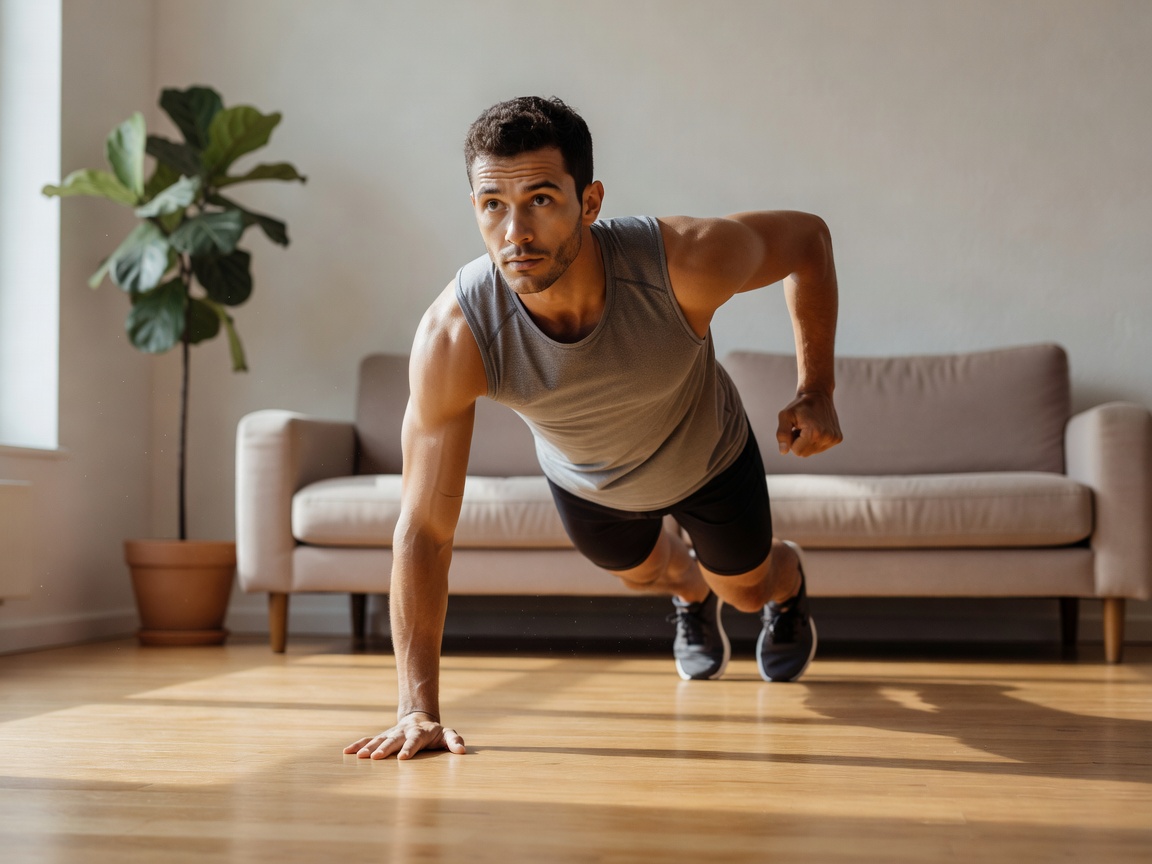
- Unilateral Shift: Transitioning from a standard two-arm push-up to an uneven push-up (one hand elevated on a block) forces one side of the body to handle the majority of the load.
- Mechanical Disadvantage: Moving the hands further back toward the hips (pseudo-planche push-ups) dramatically shortens the lever arm acting on the shoulder joint, massively multiplying the necessary torque.
The Pull-up Dilemma in Small Spaces
The horizontal and vertical pull are the hardest patterns to train using purely bodyweight on an open floor. A doorway pull-up bar is generally considered the sole non-negotiable piece of equipment for the bodyweight practitioner.
Friction-mount bars that rely purely on twisting tension are notoriously unreliable and present a safety risk. Cantilever-style bars that hook over the door trim utilize downward force to lock themselves against the frame, offering far superior stability. For those incapable of performing a strict pull-up, negative repetitions—jumping to the top position and fighting gravity on the descent—build the necessary neural pathways and eccentric strength rapidly.
Lower Body Calisthenics
Developing leg mass with bodyweight is often cited as the primary limitation of the discipline. While maximal absolute strength (like a 200kg barbell squat) cannot be replicated, profound mobility, balance, and relative strength can be built through unilateral progressions.
The progression moves from supported split squats, to Bulgarian split squats (rear foot elevated), and finally toward the pistol squat (a full depth, single-leg squat with the non-working leg extended forward). Achieving the pistol squat requires not just raw quadricep strength, but immense ankle dorsiflexion and active core compression.