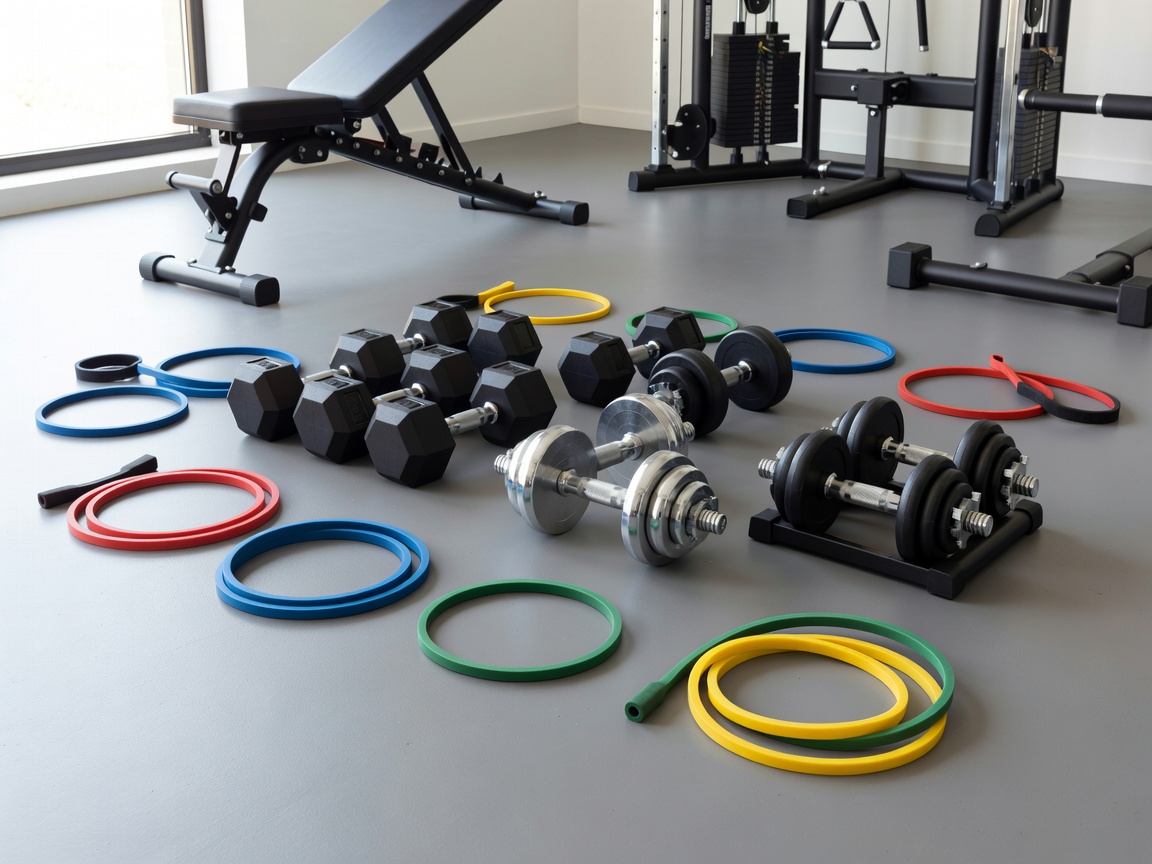
Evaluating Gear for the Home
When selecting fitness equipment for a home environment, the primary metric shifts from pure specialty to the Space-to-Utility Ratio. A piece of machinery that takes up three square meters but only trains a single muscle group—such as a leg extension machine—fails this test completely. Conversely, implements that require fractional footprints but facilitate dozens of movements represent the gold standard of home fitness investments.
Adjustable Dumbbells: Mechanisms and Trade-offs
Adjustable dumbbells are arguably the most important purchase for a home gym. They condense an entire rack of traditional dumbbells into a single pair. However, they generally fall into two distinct mechanical categories, each with specific behavioral traits.
Dial-Based Systems
Dial-based mechanisms allow the user to select the desired weight by rotating a dial at the end of the handle. When lifted, only the selected plates detach from the cradle.
- Pros: Extremely rapid weight changes; ideal for drop sets or rapid circuit transitions.
- Cons: The overall length of the dumbbell often remains constant regardless of the weight selected, which can feel bulky during pressing movements. They tend to have more fragile internal plastic components and should not be dropped.
Pin or Block-Based Systems
These systems utilize a selector pin or a sliding locking mechanism. They often have a rectangular profile rather than a traditional round plate shape.
- Pros: They expand in length only as weight is added, feeling more balanced at lower weights. Structurally, they are generally more robust and tolerate heavier impacts than dial systems.
- Cons: Changing weights takes slightly longer, and the rectangular shape can feel unfamiliar during exercises like goblet squats where the dumbbell is cradled.
Resistance Bands: Linear vs. Variable Tension
Resistance bands provide tension through elastic deformation rather than gravity. This fundamentally alters the strength curve of an exercise. Because the tension increases as the band is stretched, the exercise becomes hardest at the point of maximum contraction.
There are generally two types utilized in home setups: flat loop bands (often used for pull-up assistance and heavy compound movements) and tube bands with handles (excellent for isolation work like curls and lateral raises). Bands boast the highest Space-to-Utility Ratio of any equipment category, as an entire set can be stored in a small drawer.
Foldable Weight Benches
A bench opens up horizontal and incline pressing angles. For small spaces, foldable benches are highly desirable, allowing the user to collapse the unit and slide it under a bed or into a closet. When reviewing flat-to-incline foldable benches, stability at the hinge joint is the critical failure point. A bench that wobbles under lateral stress is a safety hazard.
We recommend looking for models that use heavy-gauge steel pins rather than friction locks, and those that offer a weight capacity significantly exceeding your combined bodyweight and maximum lift capacity.